CLICK HERE FOR BLOGGER TEMPLATES AND MYSPACE LAYOUTS »

Tuesday, August 4, 2009

'Goth subculture'
The goth subculture is a contemporary subculture found in many countries. It began in the united kingdom during the early 1980s in the gothic rock scene, an offshoot of the post_punk genre. The goth subculture has survived much longer than others of the same era, and has continued to diversify. Its imagery and cultural proclivities indicate influences from nineteenth century Gothic litereature along with horror movie and to a lesser extent the culture.The goth subculture has associated tastes in music, aesthetics, and fashion, whether or not all individuals who share those tastes are in fact members of the goth subculture. Gothic music encompasses a number of different styles. Common to all is a tendency towards a lugubrius mystical sound and outlook. Styles of dress within the subculture range from deathrock, punk, ,victorian , some Renaissenence and Medievel style attire, or combinations of the above, most often with black attire, makeup and hair.

'Origins and develop'


By the late 1970s, there were a few post-punk bands labeled "gothic." However, it was not until the early 1980s that gothic rock became its own subgenre within post-punk and that followers of these bands started to come together as a distinctly recognizable movement. The scene appears to have taken its name from an article published in UK rock weekly Sounds: "The face of Punk Gothique", written by Steve Keaton and published on February 21, 1981. The opening of theBatcave in London's Soho in July 1982 provided a prominent meeting point for the emerging scene, which had briefly been labeled positive punk by theNew3 Musical Express. The term "Batcaver" was later used to describe old-school goths.
Independent from the British scene, the late 1970s and early 1980s saw death rock branch off from American punk. In 1980s and early 1990s, members of an emerging subculture in Germany were called Grufti[e]s (English "vault creatures" or "tomb creatures"); they generally followed a fusion of the gothic and new wave with an influence of new romantic, and formed the early stages of the "dark culture" (formerly called "dark wave culture").

'The goth scene'

The bands that began the gothic rock and death rock scene were limited in number.By the mid-1990s, styles of music that were heard in venues that goths attended ranged from , death rock, industrial music, Gothabilly, EBM,ambient, experimental, shoegazing, punl rock, 1970s glam rock, indie rock,, to 1980s dance music. This variety was a result of the eclectic playlists of the Independent/Alternative music clubs.Today, the goth music scene thrives in Western-euorope in Germany large festivals such asWave-Gothic-Treffen, m'era luna and others drawing tens of thousands of fans from all over the world.HoweverNorth Americastill sees large scale events, most recently, Chamber's Dark Art & Music Festival


'Fashion'


Demographics of Japan
This article is about the demographic features of the population ofJapan, including po[pulation density, etchnity, education level, health of the populace, economic status, religious affiliations and other aspects of the population.

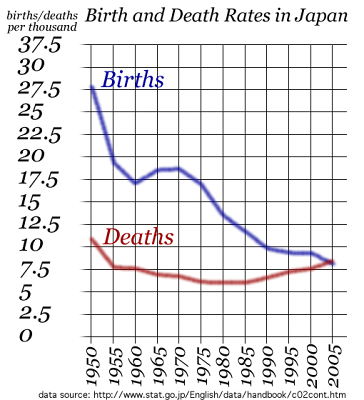
Birth and death rates of Japan since 1950
As of June 2008, Japan's Population
is around 127.7 million.Making it the world's tenth most populatedcountry. Its size can be attributed to fast growth rates experienced during the late 19th and early 20th centuries.
However more recently Japan has been experiencing net population loss, due to falling birth rates
and almost no net immigration, despite having one of the highest life expentaciesin the world, at 81.25 years of age as of 2006
Japan is also noted for its ethnically
and linguistically homogeneous population and strict laws regarding immigration.


Birth rate
In February 2007, demographers and the Japanese government announced the first significant rise in the national birth rate
in 40 years took place in 2006. The nation had an estimated 33, 500 new births that year, a sign of a small but suitable rise in the Japanese population.

Factors affecting birth rate
>Pro-natalist policies and Antinatalist policies from government
>Existing age-sex sturcture
>Availability of family planning services
>Social and religious beliefs - especially in relation to contraception
and abortion >Female literacy levels
>
Economic prosperity (although in theory when the economy is doing well families can afford to have more children, in practice the higher the economic prosperity the lower the birth rate).
>
Poverty levels – Children can be seen as an economic resource in developing countries as they can earn money.
>
Infant MortalityRate – A family may have more children if a country's IMR is high as it is likely some of those children will die.
>
Urbanization
>Typical
age of marriage
>
Pension availability
>
Conflict

Factors affecting a given death rate
>Age of country's population
>Nutrition levels
>Standards of diet and housing
>Access to clean drinking water
>Hygiene levels
>Levels of infectious diseases
>Social factors such as conflicts and levels of violent crime
>Amount and quality of health care available

Tuesday, July 14, 2009

While traditional clothes of Vietnam have always been very diverse depending on the era and occasion, after the Nguyen Dynasty women began to wear ela

While traditional clothes of Vietnam have always been very diverse depending on the era and occasion, after the Nguyen Dynasty women began to wear elaborate Áo dài for their weddings. . The style of the Nguyen Dynasty has remained popular and is still used in current-day Vietnamese wedding attire. The difference between the Áo mệnh phụ and the typical Áo dài is the elaborateness of its design. The former is usually embroidered with imperial symbols such as the phoenix) and includes an extravagant outer cloak. This gown is preferably in red or pink, and the bride usually wears a Khăn đống headdress. The groom wears a simpler male equivalent of the dress, often in the color blue.
Previous to the Nguyen Dynasty, it is likely that women simply wore fancy, elaborate versions of
Áo tứ thân.


In general, the Vietnamese are exceptionally friendly and outgoing. Be prepared for many personal questions and comments regarding your age, marital status, and weight. Easy-going people may put these types of questions. Although this may make you believe that the Vietnamese are open people, don't make the mistake of asking too many personal questions. Let the person you are talking with guide the conversation. In fact, because of reputated hospitality, they are warm, helpful and easily ignore mistakes when your behaviour doesn't apply to their standard. Above all, they also know much about the western culture.It is not unusual to be asked how much something you own costs--anything from a pen to your house back home. Don't worry about being evasive. A simple "I don't know," or "It was a gift" or even a pleasant, enigmatic smile should do the trick.

The Vietnamese get very embarrassed by displays of anger. Their usual reaction is to laugh. This is not because they do not take the situation seriously, but because they don't know how else to respond. It is not a good idea to chastise a person in front of others. This is a culture affected strongly by the concepts of pride and "face." Fortunately, there are no unique gestures that will get you in trouble.The Vietnamese eating habit tends towards vegetarianism. Rice and vegetables are the main course of the meal that may be diversified by aquatic products. Boiling is a special way of cooking of the Vietnamese people. Vietnamese people like a synthetic food processing style that involves many materials and ingredients.
Today, although meat and fish are the main dishes of the meal, the Vietnamese do not forget pickled egg-plant.The Vietnamese preferred to wear light, thin, well-ventilated kind of clothing that originated from plants and was suitable for such a tropical country as Vietnam, with grey, indigo and black colours. Men’s clothing changed from loin-cloth with bare upper half of the body to short jackets and Vietnamese traditional trousers (re-designed from Chinese trousers). In the past, women often wore brassieres, skirts and four-piece long dresses that were later modified to the modern ao dai. In general, Vietnamese women adorned themselves subtly and secretively in a society where "virtue is more important than appearance". Old/time clothing also paid attention to kerchiefs, hats and belts.
Vietnam is the country of festivities which take place all year round. The major festivities are Nguyen Dan (Lunar New Year), Doan Ngo (double five), Mid-Seventh month, Mid-Autumn Festival, etc... Each region has its own ritual holidays, the most important of which are agricultural rituals (such as the rituals of praying for rain, getting down to the rice field, and new rice...) and trades’s rituals (like the rituals of copper casting, forging, making fire crackers, and boat racing...). Besides, there are also rituals dedicating to national heroes and religious and cultural services (e.g, Buddhist rituals). Coming to Vietnam, you will have a great chance to get accustomed to a rich culture. Religion still takes a very important role in their spiritual life. When you come to worship places like temples, pagodas, etc., it's recommended not to wear so casual clothes. It is not clearly stated, but Vietnamese people may be offended if your way of dressing doesn't show your respect in those places.
Vietnamese people are very helpful. Besides, they are good at foreign languages, so it's a great advantage to foreigners. If you have any troubles, don't hesitate to ask them for a more comfortable stay.

Sunday, July 12, 2009

Assalamualaikum and a very good morning to all bloggers .We are from group 10 that consist of two group members, wani and ihsan.We are from Dip.in Forestry .we really appreciate and very thankful to Pn Joyce Morris Kapong as our english instuctor. Not forget to En.Peter that taught us to create a blogs.We hope we will enjoy the new campus life here.
" THANKS TO ALL NEW MEMBERS IN UPMKB"